


Can Scratched Floorboards Be Repaired?

A chair leg dragged across the dining room, the dog skidded through the hallway, or years of everyday wear have left the boards looking tired. If you are asking can scratched floorboards be repaired, the short answer is yes. In many London homes, scratched timber floors can be improved dramatically, and in a lot of cases fully restored, without needing to replace the whole floor.
What matters is the type of scratch, the type of wood, and the finish sitting on top of it. A light surface mark in a lacquered engineered board needs a different approach from a deep gouge in original Victorian pine. That is why good floor repair is never about guesswork. It starts with understanding what has actually been damaged.
Can scratched floorboards be repaired in every case?
Not every scratch needs the same treatment, and not every floor needs sanding from wall to wall. Some scratches sit only in the topcoat. Others cut into the timber itself. Some boards have enough wear layer left for a full restoration, while others are so thin or so badly damaged that localised repairs or replacement boards are the better route.
In practical terms, most scratched floorboards fall into one of three categories. First, there are light surface scratches that affect the finish more than the wood. Second, there are medium scratches where the coating is broken and the timber is exposed. Third, there are deep scratches, dents or gouges that physically alter the board.
This is where experience matters. The right repair should solve the visual problem without creating a worse one, such as a patchy sheen, an obvious sanded area, or a colour mismatch.
The type of scratch changes the repair
Light scratches are usually the simplest to deal with. These often come from foot traffic, pet claws, or furniture moving across the floor over time. If the mark has not cut deeply into the wood, the repair may involve buffing, re-coating, or applying a maintenance product suited to the existing finish. On oiled floors, a local treatment can sometimes blend very well. On lacquered floors, spot repairs can be less forgiving and may leave a visible edge if not handled carefully.
Medium scratches tend to need more than a surface touch-up. Once raw timber is exposed, the floor is vulnerable to dirt, moisture and darkening. In these cases, a more controlled repair is needed, often involving sanding back the affected area and restoring the finish properly. If there are multiple scratches spread across the room, full sanding and refinishing usually gives the best overall result.
Deep scratches and gouges are a different matter. These may require filling, board repairs, or in some cases replacing individual boards before sanding and refinishing the floor. If the damage runs with the grain and the timber is thick enough, a skilled restoration can often make the problem far less noticeable. If the gouge is severe or the board is split, replacement may be the more durable answer.
Solid wood and engineered wood need different handling
One of the biggest factors in answering can scratched floorboards be repaired is the floor construction itself.
Solid wood floors generally allow more scope for sanding and restoration because the timber runs all the way through. That makes them ideal candidates for repair, especially in older London properties where original boards have good thickness and character. Pine, oak and other traditional timbers can often be brought back beautifully, even when they look quite worn at first glance.
Engineered wood can also be repaired, but it depends on the thickness of the real wood top layer. Some higher-quality engineered boards can be sanded and refinished successfully. Others have a thinner wear layer, which limits how much material can safely be removed. In those cases, local repairs or partial replacement may be more sensible than aggressive sanding.
Parquet adds another layer of complexity. Herringbone and chevron floors can absolutely be restored, but repairs need to respect the pattern, species and existing finish. A rushed repair stands out quickly on a decorative floor.
Finish matters as much as the timber
A scratch in an oiled floor behaves differently from a scratch in a lacquered floor. Oiled floors are often easier to maintain locally because the finish penetrates the wood rather than forming a thick sealed layer on top. Small areas can sometimes be cleaned, lightly abraded and re-oiled with good blending.
Lacquered floors are very durable, but local repairs are harder to disguise. Once the coating is broken, patching one section can leave a difference in sheen or texture. That is why larger lacquer repairs often call for sanding and refinishing the whole room or continuous area rather than just treating one board.
Stained floors bring in another challenge: colour matching. Even when a scratch is repairable, matching an aged stain perfectly can be difficult without sanding a wider area. Sunlight, wear and previous products all affect how the wood now looks.
When a DIY repair works, and when it does not
There are cases where a homeowner can improve minor scratches. A careful clean, the right maintenance product, or a wax repair stick for a small mark may reduce how visible the damage is. This tends to work best on isolated, light surface scratches where expectations are realistic.
The problem comes when a quick fix is used on a floor that really needs proper restoration. Over-the-counter products can leave shiny patches, trapped dirt, smeared filler or uneven colour. We see this regularly in homes where the original scratch was manageable, but the attempted repair made the area more obvious.
If the scratch is deep, if the floor has multiple damaged areas, if boards are moving, gapped or splintering, or if the finish is unknown, professional assessment is the safer option. It saves time, avoids accidental damage and usually produces a result that actually lasts.
What professional floorboard repair usually involves
A proper repair starts with inspection. The floor needs to be checked for timber type, board thickness, existing finish, moisture issues and the extent of the scratching. There is no value in sanding a floor if the underlying board is unstable or if isolated replacement would give a cleaner result.
Where repair is viable, the process may include local board work, gap filling, fine sanding, stain matching and refinishing with a suitable oil or lacquer. If the scratching is spread throughout the room, full sanding is often the most cost-effective way to achieve a consistent finish.
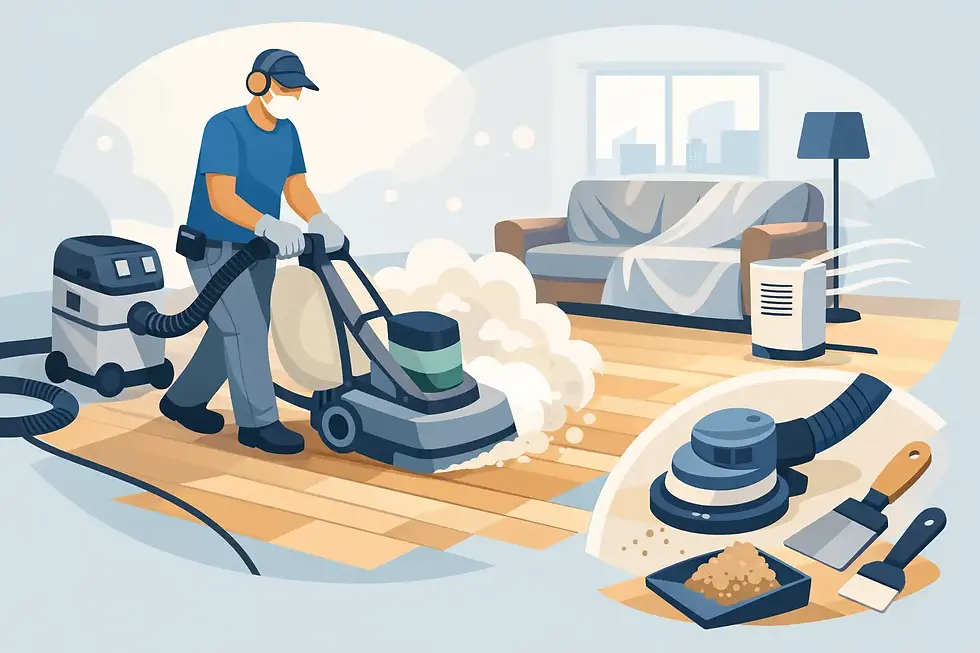
For many clients, disruption is a major concern. In an occupied home, especially in London terraces and flats, dust control makes a real difference. Modern sanding systems with high-performance extraction keep the process far cleaner than people expect. That matters when work is being carried out around furniture, decorating schedules or family life.
At Love Your Floor London, this is exactly why restoration work is planned around both the condition of the timber and the practical realities of the property. The aim is not simply to remove scratches, but to restore the floor properly with a finish that suits the room and stands up to daily use.
Is it better to repair or replace scratched floorboards?
Replacement is sometimes necessary, but it should not be the default. If only a few boards are badly damaged, replacing those boards and blending them into the surrounding floor can preserve the rest of the room and keep costs under control. This is common where there are deep gouges, historic repairs, burns or water damage in isolated spots.
If the entire floor is thin, structurally unsound or made from boards that cannot be sanded safely, replacement may be the smarter long-term investment. The same applies where previous poor repairs have left the surface uneven.
That said, many homeowners assume replacement is needed when a skilled restoration would do the job perfectly well. Original floorboards often have more life in them than they appear to. Once sanded and refinished properly, even heavily scratched floors can look transformed.
How to tell if your scratched floorboards are worth restoring
A few signs point strongly towards repair being worthwhile. The boards feel solid underfoot, the damage is mainly visual, the timber still has enough thickness, and the floor has character worth keeping. This is especially true in period homes where original boards add value and warmth that new materials rarely replicate.
You should be more cautious if boards are lifting, crumbling, heavily cupped, badly water-damaged or previously sanded too many times. In those situations, the best solution may be a combination of repair and selective replacement rather than one approach across the whole floor.
A site visit or quote is usually the quickest way to get clarity. With wood flooring, small details change the answer - species, age, subfloor condition, finish type and how the room is used all play a part.
Scratched floorboards do not automatically mean the end of the floor. In many cases, they are simply a sign that the timber is due some expert attention. The right repair can bring back the colour, smoothness and character that made you choose wood in the first place, and that is often far more satisfying than starting again.


A closer look shows that the content avoids speculative overreach at every turn. Evidence remains the primary driver of all core claims. The website contributes important background to the discussion. Interaction depth is measured against interactive media benchmarks.